QianLi Thermal Imagers Compared: 2026 Guide
Thermal imaging has become the fastest way to locate short circuits, overheating ICs, and leaking power rails on a phone board — no schematics, no probing, just heat. But QianLi and Mega Idea now offer six different thermal cameras across their lineup, and choosing the wrong one means either overpaying for resolution you will not use or bottlenecking a professional rework bench. This guide compares all six current models — Super Cam X 384, Super Cam X, Super Cam Y Pro, Super IR Cam 2S Pro, Super IR Cam Mini S, and HUBEN L256 — so you can match the right camera to your workflow.
The Full Lineup at a Glance
| Spec | Super Cam X 384 | Super Cam X | Super Cam Y Pro | Super IR Cam 2S Pro | Super IR Cam Mini S | HUBEN L256 |
|---|---|---|---|---|---|---|
| Brand | QianLi | QianLi | QianLi | Mega Idea | Mega Idea | QianLi |
| Resolution | 110,592 px (384×288) | 52,000 px (260×200) | 256×192 | 256×192 | 256×192 | 256×192 |
| Interface | Type-C | Type-C | Type-C | Type-C | Type-C | Type-C |
| Temperature Range | -20~120°C | -20~120°C | 0~120°C | -20~120°C | -20~120°C | 0~120°C |
| Languages | Chinese / English / Spanish | Chinese / English / Spanish | Chinese / English / Spanish | Chinese / English | Chinese / English | Chinese / English / Spanish |
| Color Palettes | Multiple palettes | Multiple palettes | Multiple palettes | Multiple palettes | Multiple palettes | Multiple palettes |
| Usage | Unlimited scenarios, adjustable focus | Unlimited scenarios, adjustable focus | Unlimited scenarios, adjustable focus | Unlimited scenarios, adjustable focus | Trinocular microscope mount, multi-way bracket | Unlimited scenarios, adjustable focus |
All six models share Type-C connectivity
What Resolution Actually Means on a Phone Board
Resolution is the single biggest differentiator in this lineup. The Super Cam X 384 carries a 384×288 sensor — 110,592 pixels — which is more than twice the pixel count of the 260×200 Super Cam X and roughly nine times a 256×192 unit. On a motherboard, more pixels mean smaller individual measurement spots: you can separate two neighboring ICs that are millimeters apart, watch a single capacitor heat up instead of a blurry warm zone, and capture short-circuit paths earlier in the heating curve. For heavy board-level diagnostic work, 384×288 is the clear tier above. For screen-off battery drain, charging faults, and general board triage, 256×192 is usually enough.
Model-by-Model Breakdown
Super Cam X 384 — The Diagnostic Powerhouse
With the highest resolution in the lineup (384×288), a wide -20~120°C measurement range, and adjustable focus, the Super Cam X 384 is built for shops that do constant board-level fault finding. The -20°C floor also lets you pre-cool boards and watch heat rise more dramatically, which short-circuit hunters appreciate. Spanish-language support makes it team-friendly for multi-national workshops.
Super Cam X — The Balanced Workhorse
The original Super Cam X pairs a 260×200 sensor with the same -20~120°C range and adjustable focus. It sits in the sweet spot: noticeably sharper than 256×192-class cameras when tracing heat sources, but more affordable than the 384 model. This is the model many technicians start with before upgrading.
Super Cam Y Pro — The Entry Point
A 256×192 sensor with a 0~120°C range. The narrower temperature floor is fine for board work — you are measuring components that run from room temperature up to about 100°C — but it cannot pre-cool below zero. A sensible first thermal camera for a new bench or a training classroom.
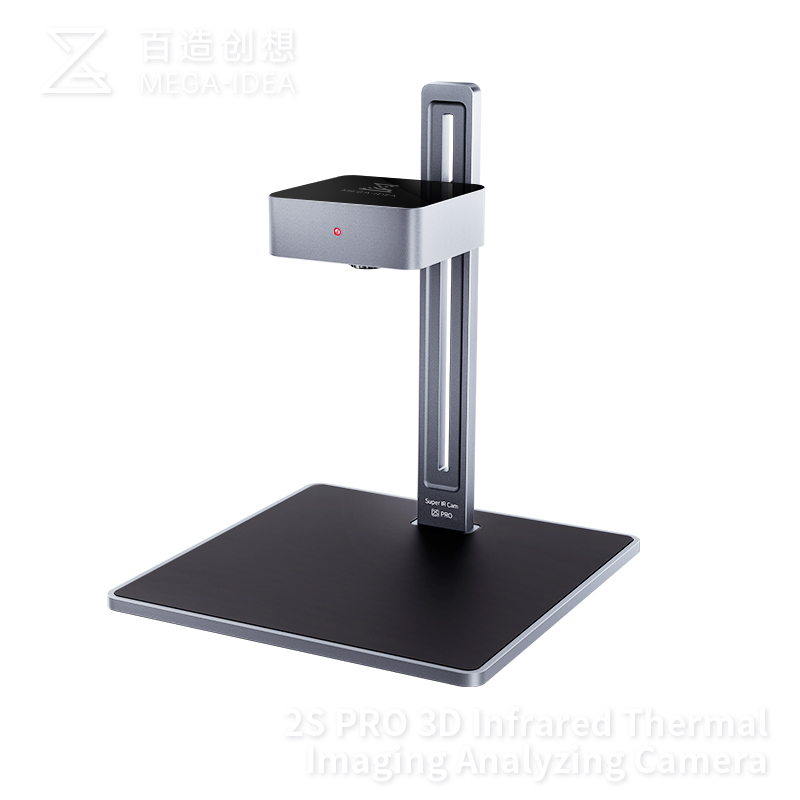
Super IR Cam 2S Pro — Mega Idea's 3D Imaging Flagship
The Super IR Cam 2S Pro brings Mega Idea's 3D thermal imaging to a 256×192 sensor with the full -20~120°C range and adjustable focus. Its 3D imaging layer overlays the thermal map more intelligently onto the board view, making it easier to say exactly which component is the heat source — valuable when you document repairs for customers or train junior technicians.
Super IR Cam Mini S — The Microscope Companion
The Mini S is the specialist: it is designed to work with common trinocular microscopes, and its bracket supports multiple ways to hold it. If your bench already runs a microscope for micro-soldering, the Mini S adds a thermal layer to the exact view you are already working under — no second monitor, no context switching. Resolution stays at 256×192 with the wide -20~120°C range.
HUBEN L256 — The Dual-Spectral Option
The HUBEN L256 is QianLi's dual-spectral thermal camera: 256×192 thermal resolution combined with a visible-light channel, a 0~120°C range, adjustable focus, and Spanish-language support. Dual-spectral fusion makes it easier to align a hot spot with the physical component underneath it — particularly helpful for technicians who are new to thermal diagnostics.
How to Choose: Match the Camera to the Job
- Constant short-circuit hunting and complex board diagnostics: Super Cam X 384 — the 384×288 sensor pays for itself in time saved
- All-round shop use with sharp imaging on a budget: Super Cam X — 260×200 is the value sweet spot
- First thermal camera or classroom training: Super Cam Y Pro or HUBEN L256 — 256×192 covers triage work, and the L256's dual-spectral view shortens the learning curve
- 3D heat-source mapping and repair documentation: Super IR Cam 2S Pro
- Bench already centered on a trinocular microscope: Super IR Cam Mini S — thermal overlay in your existing eyepiece workflow
- Multilingual teams serving Spanish-speaking staff or customers: the 384, Super Cam X, Y Pro, and L256 all include Spanish
QianLi and Mega Idea: One Ecosystem, Two Brands
Mega Idea is part of the QianLi family — the same engineering group behind the iThor screwdrivers and the F1X rework station. In practice this means shared design language, consistent Type-C connectivity across all six thermal cameras, and accessories that cross over between brands. Whichever model you pick, you are buying into one coherent diagnostic ecosystem rather than mixing vendors.
Frequently Asked Questions
Q: Do all six thermal cameras connect via Type-C?
Yes. Every model in the current lineup uses a Type-C interface, so they work with modern laptops, tablets, and phones that support the required video or data mode.
Q: Is 384×288 worth it over 256×192 for phone repair?
If you locate short circuits and micro-shorts daily, yes — the 110,592-pixel sensor gives you roughly nine times the measurement spots, which means faster and more precise heat-source isolation. For occasional triage, 256×192 is adequate.
Q: Why do some models start at 0°C and others at -20°C?
The -20°C floor (Super Cam X 384, Super Cam X, Super IR Cam 2S Pro, Mini S) lets you pre-cool components and watch heat gradients more clearly. The 0°C models (Super Cam Y Pro, HUBEN L256) cover normal board diagnostics, where components operate well above room temperature.
Q: Can the Super IR Cam Mini S replace a standalone thermal camera?
It depends on your bench. The Mini S is optimized to mount on common trinocular microscopes. If you always work under the microscope, it is ideal; if you need a free-standing camera for quick board scans away from the scope, choose a standalone model.
Q: What does dual-spectral mean on the HUBEN L256?
It fuses a visible-light image with the thermal image, so hot spots are aligned with the actual components in one view. This makes results easier to interpret, especially for technicians new to thermal diagnostics.
Q: Which models support Spanish?
Super Cam X 384, Super Cam X, Super Cam Y Pro, and HUBEN L256 include Spanish alongside Simplified Chinese and English. The Super IR Cam 2S Pro and Mini S ship with Chinese and English.
Need help picking the right thermal camera?
Vexagoo is an authorized distributor of QianLi, Mega Idea and YCS tools. Browse the Super Cam X, the Super IR Cam 2S Pro, or the FireEye Ultra portable imager, or message us on WhatsApp — we will match a camera to your workflow and ship worldwide.
Tools Mentioned in This Guide
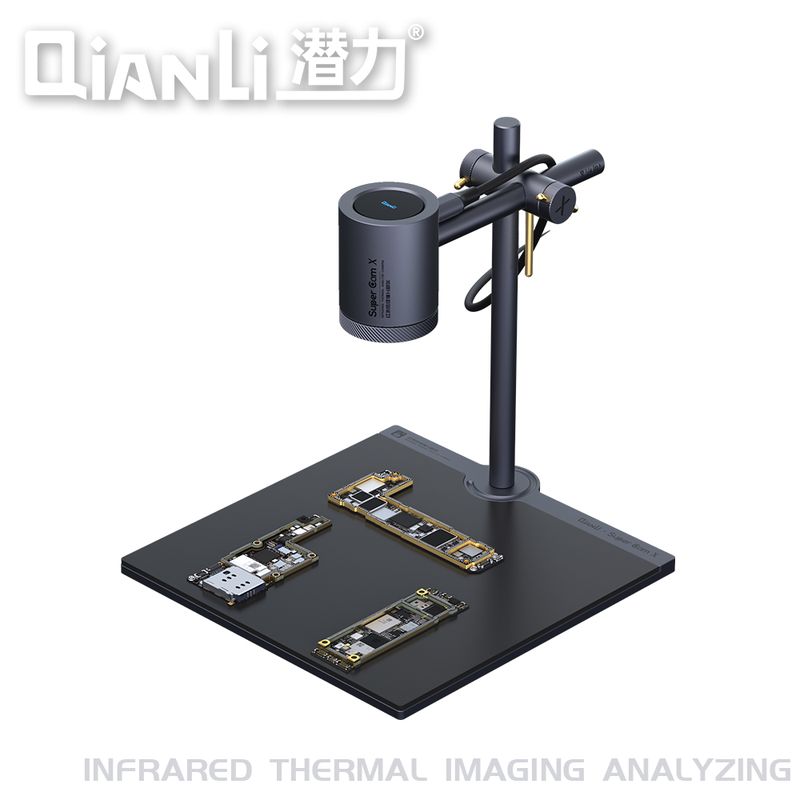
QianLi Super Cam X
The QianLi Super Cam X is a high-resolution thermal imaging camera for detailed motherboard analysis - finding shorts, overheating components, and corrosion with greater thermal detail. The professional choice for advanced board-repair labs and training centers.
View Details →Mega-Idea Super iR Cam 2S Pro
The Mega-Idea Super iR Cam 2S Pro is a 3D infrared thermal imaging camera for phone repair. A 256×192 sensor, 25 Hz refresh, adjustable vertical column, and full-frame temperature measurement turn the motherboard into a live heat map, while the PCBA electricity-leakage quick check mode pinpoints shorted components.
View Details →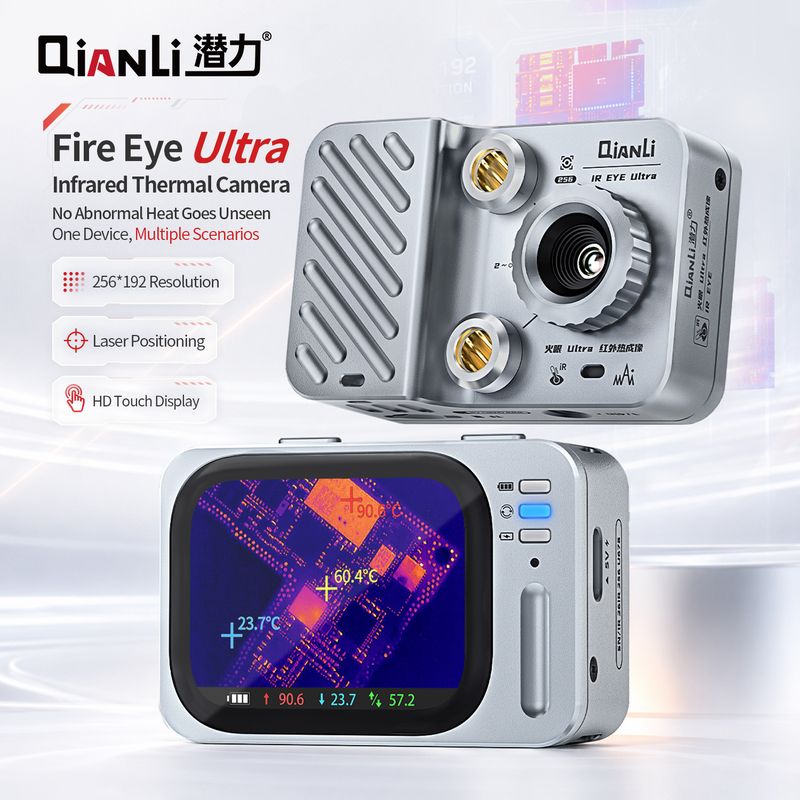
QianLi FireEye Ultra
The QianLi FireEye Ultra is a portable infrared thermal imager that finds short circuits, overheated ICs, and water-damage hotspots in seconds - no schematics needed. The fastest diagnostic tool for motherboard repair, compatible with IP series and Android boards.
View Details →